Assessment & Evaluation
CLASS® Score Sheets - PreK Forms - Set of 10 - Spanish
Item: 29059
Status: In Stock
$50.00
Available in packages of 10 booklets, each with 6 observation sheets and 1 scoring summary sheet, these are Spanish forms for conducting the Classroom Assessment Scoring System® (CLASS® ) observation. These forms are a part of CLASS®, the bestselling classroom observational tool that measures interactions between children and teachers -- a primary ingredient of high-quality early educational experiences. With versions for toddler programs, PreK, and K-3 classrooms, the reliable and valid… More »
DECA-I/T Toddler Record Forms
Item: 13845P
Status: In Stock
$29.95
For use with DECA-IT kit for children ages 18 months up to 36 months. Set of 30.
LAP™-D - 3rd Edition Bilingual Scoring Booklet - Pack of 20
Item: 12337
Status: In Stock
$29.95
Pack of 20 LAP™-D Bilingual Scoring booklets.
CLASS® Dimensions Overview - PreK - Grade 3 - Set of 5
Item: 29055P
Status: In Stock
$50.00
This tri-fold laminated sheet is a handy reference for users of the popular CLASS® observation tool. Available in convenient packages of 5, this sturdy quick-sheet shows evaluators what to look for while observing each of the 10 CLASS® dimensions and scoring the tool. This product is part of CLASS®, the bestselling classroom observational tool that measures interactions between children and teachers -- a primary ingredient of high-quality early educational experiences. With versions… More »
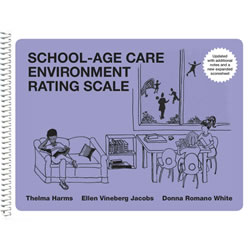
School-Age Care Environment Rating Scale®, Updated (SACERS - Updated™)
Item: 27946
Status: In Stock
$30.95
What are the components of high-quality after-school care for children ages 5-12? How can we evaluate these programs? These are the challenges facing caregivers, schools, agencies, and parents as after-school programs proliferate. The School-Age Care Environment Rating Scale®, Updated Edition provides an easy-to-use resource for defining and assessing the quality of both public and private programs caring for school-age children during out-of-school time. This updated, spiral-bound edition is… More »
Early Childhood Environment Rating Scale®, Revised (ECERS-R™) - Spanish
Item: 46798
Status: In Stock
$30.95
This widely used program quality assessment instrument is designed for preschool, kindergarten, and child care classrooms serving children 2 1/2 through 5 years of age. It can be used by program directors for supervision and program improvement, by teaching staff for self-assessment, by agency staff for monitoring, and in teacher training programs. The established reliability and validity of the ECERS-R™ make it particularly useful for research and program evaluation.
Infant/Toddler Environment Rating Scale®, Revised (ITERS-R™) - Spanish
Item: 11218
Status: In Stock
$28.95
By Thelma Harms, Richard M Clifford, Debby Cryer, From the Frank Porter Graham Child Development Institute of North Carolina. Evaluates physical environment, basic care, curriculum, interaction, schedule, program structure, and parent and staff education.<scribe-shadow data-crx="okfkdaglfjjjfefdcppliegebpoegaii" id="crxjs-ext" style="position: fixed; width: 0px; height: 0px; top: 0px; left: 0px; z-index: 2147483647; overflow: visible; visibility: visible;"></scribe-shadow>

LAP™ Blank Square Pad - Set of 10
Item: 8375
Status: In Stock
$39.95
10 pack of blank square paper pads.