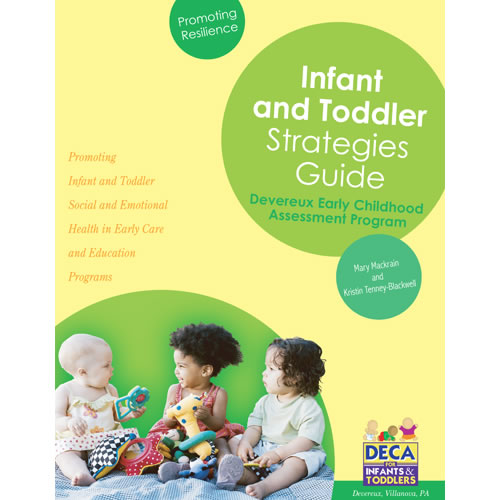
This guide provides research-based, simple, easy-to-use social and emotional strategies for the home and childcare setting. With hundreds of strategies, organized into five chapters, this guide is a wonderful reference for any caregiver who is interested in promoting the social and emotional health of infants and toddlers.
The DECA-P2 Record Forms are strength-based, nationally standardized, reliable, valid, and easy-to-use! These sets includes 40 assessment forms and a pad of 40 individual child profile forms. Sets available in English or Spanish.
These guides offer families simple strategies to support young children's healthy social and emotional development. Filled with suggestions of everyday activities that families can enjoy together and promote three key protective factors: initiative, self-regulation, and attachment/relationships. Booklets (40 pages) are available in English or Spanish in sets of 20. Copyright 2013.
Through footage of ASQ-3® tasks and close-ups of sample questions and scores, learn how to score the questionnaires accurately and decide if a referral for further assessment is needed.
The CLASS® 2nd Edition Infant-Third Reference Manual contains the research behind the CLASS tool, and provides additional insight and guidance on using CLASS within a CQI process and system. Available in English and Spanish
Keep interactions top of mind with this handy guide that builds understanding of the CLASS framework. The CLASS® Infant-Toddler Interactions Dimensions Guide is designed for ease of use, offering concise explanations of CLASS domains and dimensions, along with descriptions of effective interactions and practical strategies. This guide is ideal for educators, coaches, and anyone looking to understand the importance of interactions. Available in English or Spanish.
CLASS® 2nd Edition Infant-Toddler Observation Score Sheets must be used by those conducting CLASS observations in infant and toddler settings. Each booklet contains six observation sheets and one scoring summary sheet for recording notes and scores. Available in packs of 5 booklets, totaling 30 observation sheets. Available in English or Spanish.
Give your child-care program a strong social-emotional foundation with the Complete TPITOS™ (Teaching Pyramid Infant-Toddler Observation Scale). This scale helps caregivers of children from birth to 3 years old evaluate the social-emotional quality of their programs by measuring how well they cultivate nurturing relationships and bolster solid social-emotional development. Caregivers and centers that use this scale will empower themselves to provide the best possible care because they will… More »
Each booklet contains six observation sheets and one scoring summary sheet for recording notes and scores. Available in packs of 5 booklets, for a total of 30 observation sheets. English and Spanish version available.
Give preschool classrooms a strong social-emotional foundation with the Complete TPOT™ (Teaching Pyramid Observation Tool). This tool helps teachers and directors in preschool programs that serve children from 2-5 years old evaluate the social-emotional quality of their programs by measuring how well they cultivate nurturing relationships and bolster social-emotional competence. Programs that use this scale will empower themselves to provide the best possible care because they will know what… More »
Support the social-emotional development of young children through these engaging learning activities, handouts, and additional resources. These books, available in both English and Spanish, provide practical strategies for caregivers of children from birth to 6 years old. Features over 90 age-appropriate activities, nine informative newsletters for parents, and one-page summaries addressing key topics. Includes keycode access inside ASQ online.
Unpacking the Pyramid Model is an informative, comprehensive guide to creating socially and emotionally sound preschool environments. The book offers a step-by-step overview of the Pyramid Model, which is a developmental framework that promotes social-emotional competence in universal, targeted, and individualized ways. It also includes chapters on building good relationships with families and colleagues that will empower early childhood educators to create the effective workforce necessary to make the Pyramid Model work
Unpacking the Infant-Toddler Pyramid Model is an informative, comprehensive guide to creating socially and emotionally sound infant-toddler care environments. The book offers a step-by-step overview of the Pyramid Model, which is a developmental framework that promotes social-emotional competence in universal, targeted, and individualized ways. It also includes chapters on practicing self-care and building good relationships with families and colleagues, which will empower caregivers to create the… More »
Want to learn to FLIP IT, but can't make it to a training? No problem! Learn to FLIP IT at your own pace and on your own time by choosing the FLIP IT!® Online Course, 2nd Edition. The entire length of the course is approximately 2.5 hours including interaction, reflection, application of skills learned with FLIP IT and a final assessment. Most importantly, this course can be taken module by module and not all in one sitting. Empower yourself and your colleagues by purchasing this course today!… More »
The new third edition of this widely used assessment tool focuses on the full range of needs of infants and toddlers up to 36 months of age and provides a framework for improving the quality of center-based infant/toddler programs. ITERS-3 assesses both environmental provisions and teacher-child interactions that affect the broad developmental milestones of infants and toddlers, including: language, cognitive, social-emotional and physical development as well as concern for health and safety. Includes… More »
The long-anticipated new version of the internationally recognized Early Childhood Environment Rating Scale®, ECERS-3™ focuses on the full range of needs of preschool- and kindergarten-aged children. This widely used, comprehensive assessment tool measures both environmental provisions and teacher-child interactions that affect the broad developmental needs of young children, including cognitive, social-emotional, physical, and health and safety. ECERS-3™ also includes Items assessing… More »
Building on feedback from the field, as well as current research on supporting young children's development and learning, the authors have revised and updated the widely used Family Child Care Environment Rating Scale®. FCCERS-3 is the next-generation assessment tool for use in home-based child care programs for children from infancy through school age (birth to age 12).FCCERS-3 focuses on the full range of needs of the wide age-range of children often found in family child care programs. Further,… More »
What are the components of high-quality after-school care for children ages 5-12? How can we evaluate these programs? These are the challenges facing caregivers, schools, agencies, and parents as after-school programs proliferate. The School-Age Care Environment Rating Scale®, Updated Edition provides an easy-to-use resource for defining and assessing the quality of both public and private programs caring for school-age children during out-of-school time. This updated, spiral-bound edition is… More »
In a translation approved by the authors, this is the Spanish edition of the newly revised Family Child Care Environment Rating Scale® (FCCERS-R). Designed for use in family child care programs, this widely used program quality assessment instrument is suitable for programs serving children from infancy through school-age. Following extensive input from users of the original scale, the authors have made many improvements and innovations that will make this program resource even more effective… More »
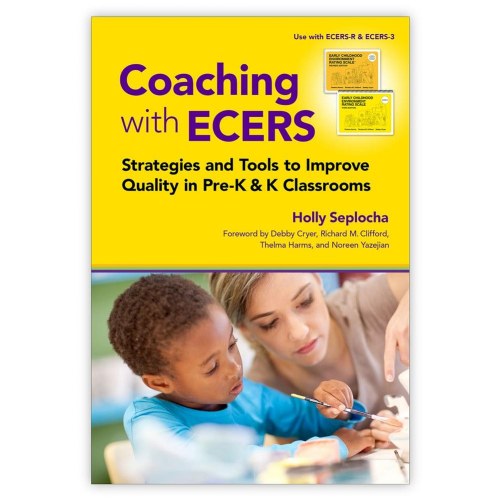
Coaching with ECERS presents best practices for coaches to use in their work with teachers and administrators to help them improve classrooms and teaching practices. The author includes guidance and activities for facilitating group meetings, professional learning communities, and staff workshops. Appropriate for use with ECERS-R™ and ECERS-3™. Paperback. 120 pages.
By Thelma Harms, Richard M Clifford, Debby Cryer, From the Frank Porter Graham Child Development Institute of North Carolina. Evaluates physical environment, basic care, curriculum, interaction, schedule, program structure, and parent and staff education.<scribe-shadow data-crx="okfkdaglfjjjfefdcppliegebpoegaii" id="crxjs-ext" style="position: fixed; width: 0px; height: 0px; top: 0px; left: 0px; z-index: 2147483647; overflow: visible; visibility: visible;"></scribe-shadow>
The increasing concern over the effect of child care on children's lives has focused attention on the quality of that care. Since most out-of-home care is provided in family child care homes, the need has grown for an accessible, reliable, and thorough means of assessing the quality and suitability of such settings. Developed through lengthy field testing, research, and revision, the Family Child Care Environmental Rating Scale consists of 32 items, organized under six major headings: Space and… More »
The ASQ:SE-2® Quick Start Guide is a convenient, at-a-glance guide that keeps ASQ:SE-2® scoring and administration basics right at the fingertips. Perfect for busy professionals on the go, this Quick Start Guide is laminated, lightweight, and so cost-effective that every professional in a program can have one (it's sold in a package of 5). ASQ:SE-2® users will turn to the Quick Start Guide for clear, simple directions on selecting the correct questionnaire, scoring ASQ:SE-2®, and… More »
🍪 This website uses cookies to ensure you get the best experience on our website.